Your assessment didn't find a low score. It found two specific gaps, the exact spots where scammers already know careful people get caught. That gap is the whole story here, not a verdict on you.
Two specific weak points. One system built to close both, and everything else you haven't hit yet.

The ones that actually work don't feel like danger. They feel completely ordinary, right up until the moment they need you to act before you check.

An overall score was never the useful number. The gap between your strongest and weakest domains is, because that gap is the only thing a scammer is actually looking for.
Most people mentally file scams under "phishing emails" or "phone scams." In practice, scams enter through nearly every ordinary channel in your life, each one dressed differently.
The cost of getting this wrong is rarely just financial. It's the hours spent untangling accounts afterward. It's the awkward call to warn a family member. It's trusting your own judgment a little less, for a while. Money is usually the smallest part of the bill.
This isn't about memorizing hundreds of scam types, that's an impossible task, and it's exactly what scammers are counting on. Here's exactly what happens between spotting something's wrong and knowing it's actually handled, mapped to your two flagged areas.
Research from the Financial Industry Regulatory Authority found that people aware of a specific scam are 80 percent less likely to interact with it at all, and even if they do engage, 40 percent less likely to fall victim. Awareness genuinely works. This is not a hopeful assumption. It is a measured effect.
Source: FINRA Investor Education Foundation · cited in The Scam Survival System, Chapter 69New apps, new technology, new stories, the scam types multiply constantly. But strip away the disguise and the underlying mechanisms driving nearly all of them come down to a short, stable list.
The system includes a Symptom & Scenario Quick-Index, four Guided Reading Paths built for specific situations, and a Cross-Reference Map connecting chapters that share a mechanism, so the right starting point is never Chapter 1 by default.
See the system applied to your situation.
Here's the kind of thing The Scam Survival System teaches you to do.
Watch the S.T.O.P. method scan a real-looking suspicious message, live →
Hover or press and hold to pause and study each step.
Every piece of generic advice below is true. None of it tells you what to actually do in the moment.
A quick search turns up thousands of articles telling you to be careful, verify senders, and watch for red flags. All of that is true. None of it tells you what to actually do at 9pm when your phone rings and something feels wrong.
Every chapter pairs a real scenario with a repeatable method, a concrete action, and a matching tool, built to be used, not just read.
Information tells you what exists. A system tells you what to do.
Scams aren't primarily a technology problem. They're a persuasion problem, and the same handful of levers, urgency, authority, fear, greed, social proof, reciprocity, commitment, show up in a fake romance profile, a fake IRS call, and a fake investment platform alike. They're engineered to operate below conscious awareness. The goal was never to make you suspicious. It was to make sure you never had the chance to be.
The same handful of levers, urgency, authority, fear, greed, social proof, reciprocity, commitment, show up in a fake romance profile, a fake IRS call, and a fake investment platform alike. They're engineered to operate below conscious awareness, which is exactly why this applies to everyone, not just people who think of themselves as easy targets.
A stranger online compliments your trading instincts, shares screenshots of impressive returns, asks for a small deposit "just to see how it works." Weeks later, after several small, real-looking withdrawals build trust, the ask grows, framed as urgent. Four manipulation levers, stacked in sequence, each one making the next feel like a natural continuation of what you already agreed to.
The system is explicit about this: these techniques are engineered to work on careful, intelligent people too, not despite their caution, but often because that very sophistication becomes one more thing to work with.
Noticing the lever while it's being pulled is what breaks it. That's the entire skill this system builds.
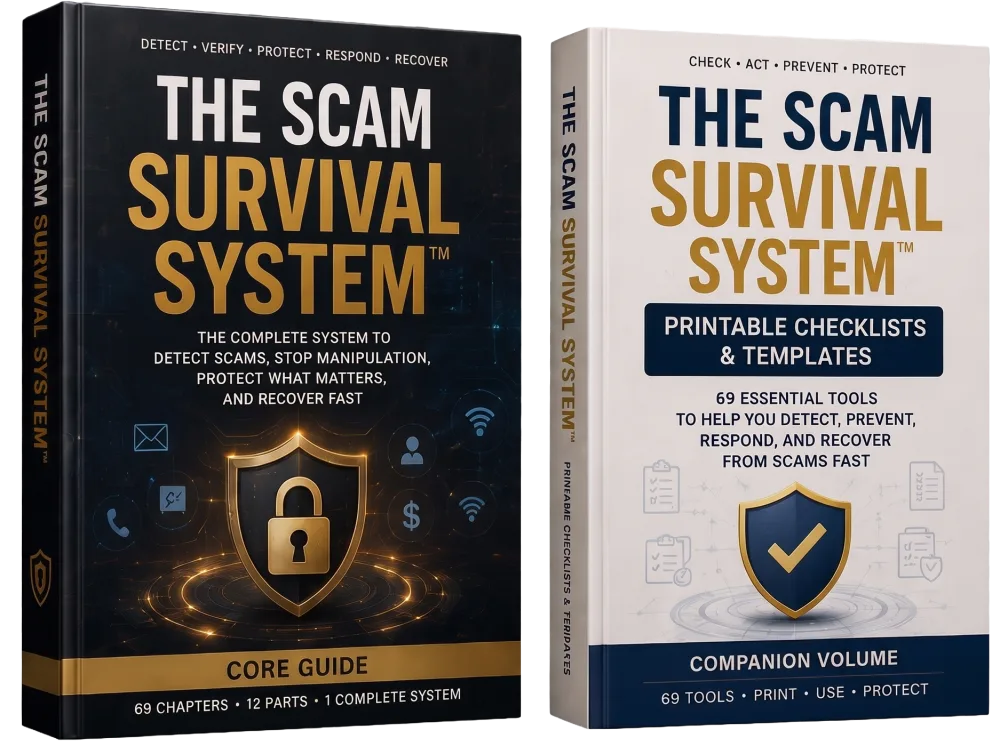
The system includes a Symptom & Scenario Quick-Index, four Guided Reading Paths built for specific situations, and a Cross-Reference Map connecting chapters that share a mechanism, so the right starting point is never Chapter 1 by default.
You're not buying information you'll forget. You're building a reference system you can return to.
You can't predict when a scam will target you, or which shape it takes when it does. What you can control is whether a system is already in place before that moment arrives.
If it isn't genuinely useful to you, that's the end of it, no argument, no guilt, no need to justify anything. We'd rather you use the system and know it's valuable than keep your money if it isn't.
Covered by a full 30-day guarantee, no conditions attached.
If this is the first time you're encountering ForgeWise, that's a fair thing to weigh before spending anything, especially in a category built entirely on deception. Here's exactly what that trust is based on.
Two minutes, no cost, no obligation. See exactly which two areas are worth your attention most, before you commit to anything.
No. The Core Guide pairs with a 69+ tool Companion volume, a Scenario Quick-Index, Guided Reading Paths, and a Cross-Reference Map, built as a reference system you return to, not a book you read once cover-to-cover.
No. The Scenario Quick-Index gets you straight to the chapter matching your exact situation, and the Guided Reading Paths pull 6 to 10 relevant chapters into a sequence for specific situations, like becoming a caregiver, without reading the rest.
No. The system includes dedicated material for parents protecting children and teens, small business owners facing invoice fraud, and immigrant households facing language-specific scams, alongside material for older adults and everyone in between.
Yes, extensively. A full dedicated section covers AI voice cloning, real-time deepfake video calls, AI-generated phishing and chatbot scams, and synthetic identity fraud, treated as its own priority given how fast this threat is evolving.
Start with the Emergency Response Protocol for the first hour, then the Scenario-by-Scenario Recovery Playbooks for your exact situation. Credit-monitoring, reporting, and emotional-recovery material are included too, this covers what happens after, not just before.
No system can honestly promise that, and any that claims to isn't being straight with you. What this system does is make you significantly harder to manipulate, and faster to respond if something does get through.
The system includes a dedicated chapter on tracking emerging scam trends as tactics evolve, plus a 90-Day Habit Builder to keep the underlying skills current, so staying up to date doesn't require buying a new guide every year.
Yes. Detection is only one of eight domains covered, alongside password and device security, digital footprint exposure, AI literacy, and recovery-readiness. Most people are stronger in some domains than others, even people who consider themselves generally aware.
Instant digital access to the Core Guide and Companion volume immediately after purchase, no shipping, no waiting. Both are yours to keep and return to anytime.
This is meant for your immediate household, the people you live with and are actively responsible for protecting. The Family & Social Exposure material and household-protection tools are built specifically for that, so everyone under your roof can use the same system, not just you.
You can't know in advance which channel it arrives through, whose voice it borrows, or which of your habits it's built to exploit. What you can control, entirely, is whether a system is already in place before that moment arrives.
Start Today →The Scam Survival System™ is an educational resource designed to improve your ability to recognize and respond to manipulation and fraud tactics. No system, product, or guide can guarantee immunity from all scams, and this system does not claim to. Results depend on individual application. This material does not constitute legal, financial, or professional advice.